
How to Search Criminal Dockets
Wood County splits its criminal dockets across several courts. The first move is finding which one handled the case. Check the complaint, notice, or ticket for the court name. For Common Pleas criminal matters, the Wood County Clerk of Courts sends searchers to CourtView eAccess. Bowling Green and Perrysburg keep their own adult misdemeanor and traffic dockets. So does the Fostoria location of Tiffin-Fostoria Municipal Court. Juvenile delinquency and juvenile traffic cases sit in a separate court. That court has its own access rules.
When you have a case number, copy it exactly as it appears. A name can steer a municipal docket search in the right direction. But a case number is the surest way to request a copy or confirm a court date. Treat online results as reference material only. They are not a certified court record.
- Read the court name, location, and case number on the notice or available paperwork.
- For a felony or General Division matter, open the Clerk’s Dockets Online route and continue to CourtView.
- For a municipal matter, use the court’s own record route or contact its clerk. Do not substitute a municipal payment screen for a full criminal docket.
- Read entries in time order and compare a setting with the current notice or the responsible court office.
- Request the record from the custodian when a copy, certification, or older file is needed.
Wood County Felony Docket Route
Felonies in Wood County belong to the Prosecutor's Criminal Division. That division files those charges in Common Pleas. Once a case is filed, the public route to the criminal docket runs through the Clerk's CourtView eAccess. That system covers Common Pleas docket entries, not the municipal criminal files handled by other clerks. For an official document, the Clerk remains the right office. Its legal division files, records, indexes, and preserves all Common Pleas pleadings.
The Wood County Clerk's Dockets Online page marks the official starting point. It is where a Wood County criminal docket search begins.
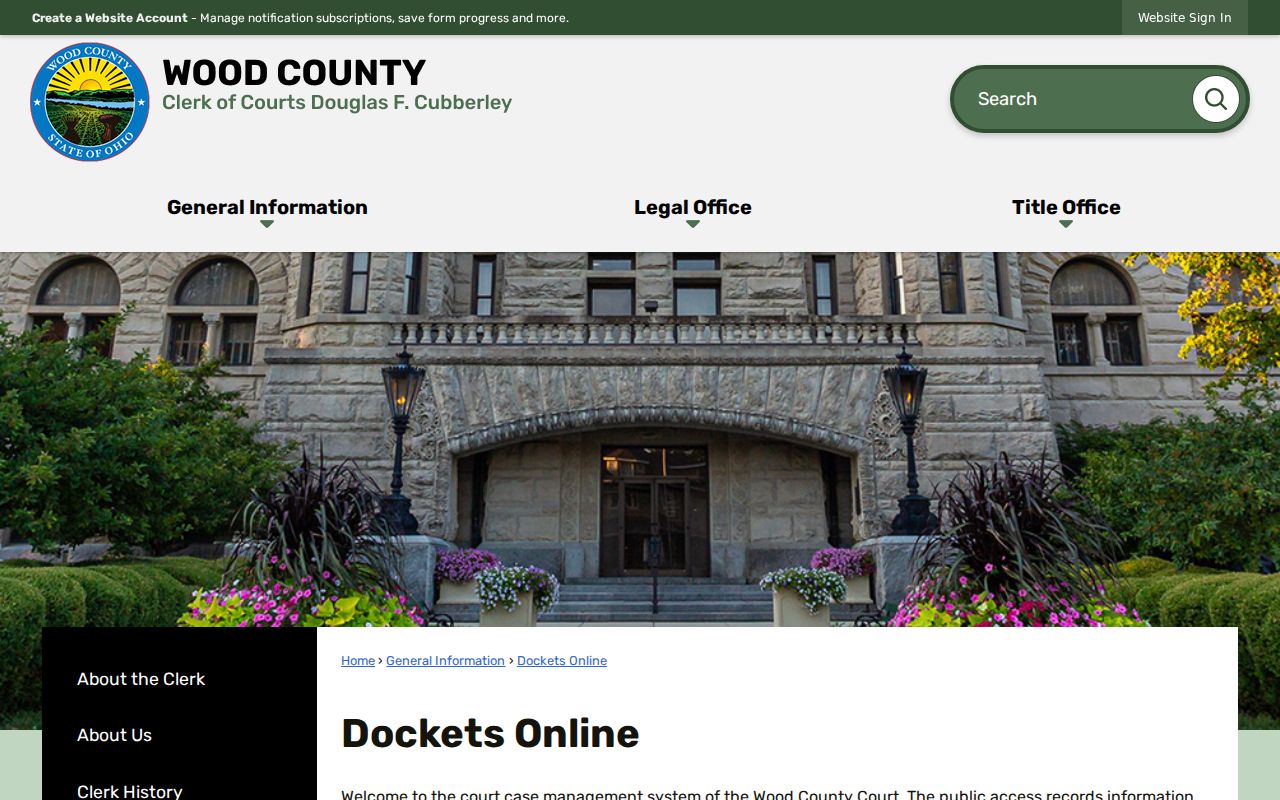
The entry page matters here. CourtView is the Common Pleas path, while a separate municipal clerk holds many lower-level criminal case files.
Wood County Criminal Docket Timing
CourtView's public landing page puts a CAPTCHA in front of the search. Do not count on any particular name, charge, or date filter once you get through. The Clerk also cautions that new filings and judicial actions take time to appear. Records before 1990 may be missing from the online docket entirely.
A delay or a gap does not mean the case failed to exist or that a hearing changed. Keep the case number handy. Then call the Clerk at 419-354-9280. You can also inspect the court records for free in person if the online entry is missing, recent, or confusing. Remember that a CourtView display comes from computerized records. It is not warranted as a certified copy.
What a Criminal Docket Shows
A docket is a running index of everything filed in a case, in order. Think of it as a timeline. Each entry marks a filing, a hearing, or a fee. The Clerk keeps docket entries in CourtView. The public landing page does not spell out every field or code inside a case result, though. So the reading tips that follow are safe general habits. They are not a promise that Wood County shows every label in every criminal docket result.
| Case number | The court’s identifier. Preserve the exact number shown; an official Common Pleas criminal format was not visible past the CAPTCHA. |
|---|---|
| Court or division | Identifies whether the matter belongs in Common Pleas, a municipal court, or Juvenile Court. |
| Docket entries | Chronological filings, orders, and procedural events, subject to posting delay. |
| Setting notice | A date and purpose for court activity; confirm an individual setting with the docket or court office. |
| Order or judgment | A ruling recorded by the court. A certified copy comes from the appropriate clerk or court. |
One caution is worth learning early. A docket entry is only a summary line, not the pleading itself and not a clerk-certified judgment. Its real value is that it tells you what document to request, and from which office.
Wood County Municipal Criminal Clerks
Not every charge ends up in the Common Pleas felony docket. Adult misdemeanors and many traffic cases stay in municipal court. Which one depends on where the case falls geographically. Bowling Green provides a Case Information route through GovRec. It also offers free criminal and traffic lookup terminals at the courthouse. Perrysburg runs a Criminal/Traffic Division. The Fostoria location handles scheduled traffic and criminal sessions for Tiffin-Fostoria Municipal Court. So the right Wood County municipal clerk depends on territory, not on the seriousness of the ticket or charge alone.
| Criminal docket | Online path or observed input | Document fallback |
|---|---|---|
| Bowling Green | GovRec case/record search; JavaScript fields were not captured | Free terminals or Clerk, 419-352-5263 |
| Perrysburg | Payment search uses required Last Name and optional First Name | Criminal/Traffic Division, 419-872-7904 |
| Fostoria location | CaseLook continues past a notice; fields were not exposed before acceptance | Clerk, 419-435-8139 |
The Wood County Prosecutor's criminal filing information lays out this split between felony prosecutions and municipal-court options in plain terms.
Before you try to read any Wood County criminal docket result, settle one fact first: which clerk's office holds the case.
Wood County Criminal Setting Terms
Familiar words on a Wood County criminal docket do not always mean what they sound like. Take "pretrial." In Perrysburg materials, it is a conference about the issues in the case, nothing more. An arraignment, per Tiffin-Fostoria, is when the court goes over the charge, the person's rights, and the plea. Both terms describe steps, not endings. A Common Pleas criminal docket day works the same way. It is a scheduling event for the court assigned to those matters. It does not promise that every listed case has its own individual hearing time. Read the setting for what it is. Then let the docket entries, not the label, tell you where things stand.
- Arraignment
- An early criminal or traffic proceeding that addresses the charge, rights, and plea.
- Pretrial
- A conference before trial to address issues, resolution, or next steps.
- Continuance
- A court-approved postponement. A request alone does not move a date.
- Disposition
- The outcome or closing action recorded in a case.
Stages on a Criminal Docket
Think of a criminal docket as a story told in order. A Wood County Common Pleas felony often starts with a filing or an indictment. Next comes the arraignment. Then hearing activity and motions follow. A plea or a trial comes next. Finally, a judgment or sentence appears if the case reaches that point. Municipal cases in Wood County usually run a shorter course. Even so, the court itself controls the exact procedure. The live docket is the only place to confirm a case's current status.
Docket flow: Filing → Arraignment → Pretrial → Plea or Trial → Disposition → Sentencing
The docket entry itself supplies the actual wording, so go to the live record when the precise language matters. Need formal proof? Ask the clerk for the judgment or the underlying court record rather than trusting a screen result.
Wood County Payment Screens and Dockets
Paying online settles a fine, but it never hands you a full criminal docket. In Perrysburg, the payment search sits apart from other routes. Court Records, Criminal, Traffic, and Civil searches are separate. One eligible Fostoria citation can spawn more than one related case. A single ticket may carry as many as seven charges. You might see TRD10000001A plus later letter suffixes, all tied back to that same citation. So before assuming anything, line up every lettered case number. Match each one to the citation it grew from. Ohio law treats these records seriously. Ohio’s adult sealing and expungement statute spells out how past cases can later be sealed. That is one more reason a public search result deserves careful reading.
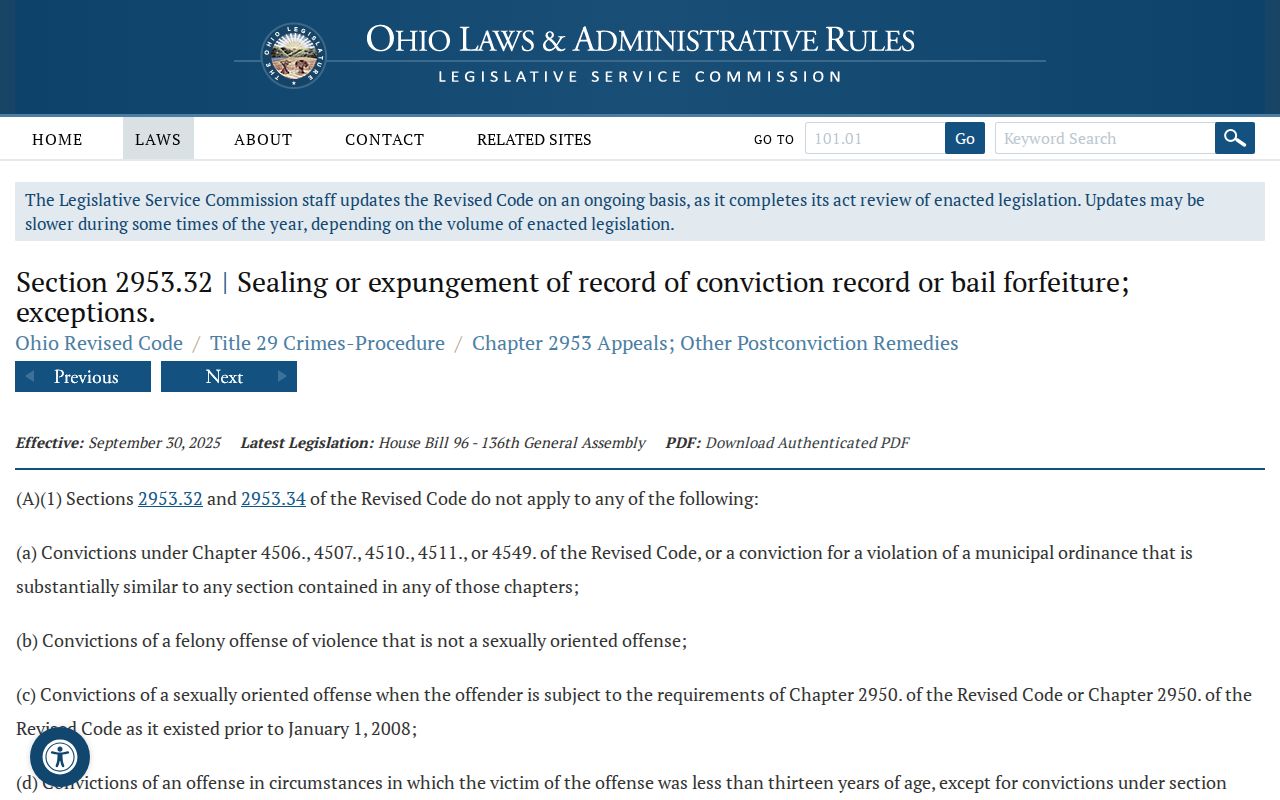
Don't pay or draw a conclusion from a single screen. Match the full citation and every related case number to the right municipal court record first.
Wood County Criminal Setting Check
A confusing Common Pleas criminal setting usually has a simple fix. Check the notice or docket for Court #1, Court #2, or Court #4 before picking up the phone. The public calendar groups recurring criminal docket events by judge and court number, though many cards read as all-day entries rather than exact hearing times. For anything case-specific, the docket itself and the court team answer better than the calendar. Each court has its own published line: 419-354-9210 for Court #1, 419-354-9220 for Court #2, and 419-354-9600 for Court #4. The Common Pleas judges and case-manager page shows how each court's staff is organized, which helps you reach the right team on the first call.
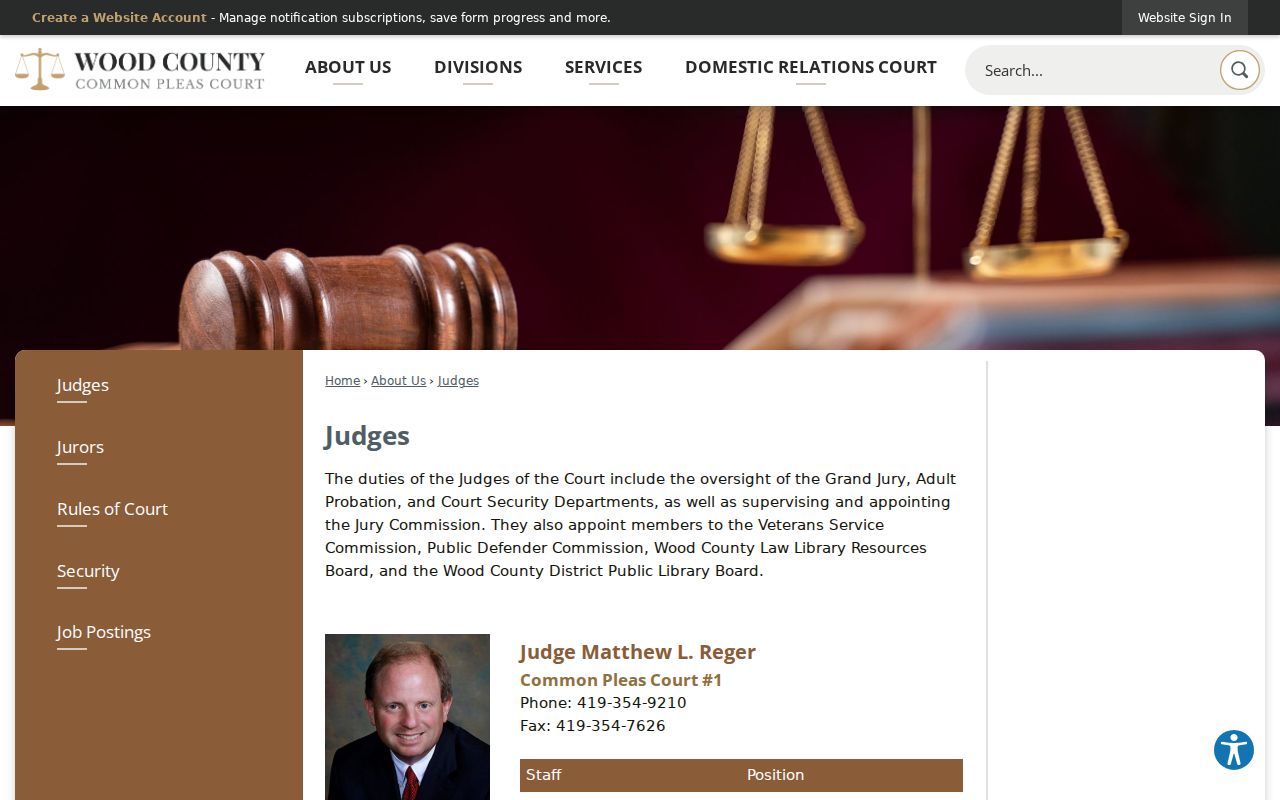
Municipal cases work the same way. Compare the docket or notice against that court's published session blocks, and call the clerk if the two conflict.
Which Court Holds Criminal Dockets
Felony charges in Wood County land in the Court of Common Pleas, General Division. That is the county's principal criminal docket for felonies. The Wood County Clerk of Courts holds those Common Pleas records. The same office also keeps Sixth District Court of Appeals filings. Filing a notice of appeal opens an appellate docket. But the trial-court record still stands on its own. Misdemeanors and traffic cases belong to Bowling Green, Perrysburg, and Tiffin-Fostoria Municipal Courts, each within its own territory. Juvenile Court handles delinquency and juvenile traffic under stricter confidentiality rules. This split in custody matters. A Wood County case lookup has to start by identifying the right court, not by typing one name into a single search box.
Wood County Criminal Docket Context
The Common Pleas 2024 annual report counted 591 criminal cases completed. Behind that total sat 416 pre-arraignment reports. There were also 42 intervention-in-lieu reports and 92 expungement or record-sealing reports. Those numbers measure court workload, not online search results. Still, they explain why a criminal docket may show a court team, probation, or a separate report. Any of those can appear before a final entry.
Support programs sit close to the docket itself. The Wood County Adult Probation information shows how supervision work connects to the wider criminal docket process.
Program statistics never tell you where a case stands now. Confirm any entry in the responsible court record before relying on it.
Wood County Criminal Docket Copies
An online docket entry tells you which event to ask about. A clerk copy gives you the actual document or certification. Wood County's Clerk offers a public-records form with no-charge inspection in the office. Copies go out by pickup, mail, or email. Certified copies go out by mail only. Expect $0.10 per photocopy page and $1 per certification. A broader fee posting adds transaction-specific charges. Ask the Clerk to quote the request before sending payment.
| Reference view | Clerk record route |
|---|---|
| CourtView docket entries may post after a delay | Request a copy, certification, or inspection through the Clerk |
| Useful for tracking chronology and a case number | Useful for the official document behind an entry |
| Not represented as a certified copy | Certification is a separate clerk service |
Public Access and Sealed Criminal Dockets
Ohio presumes its court records open. Access still bends to the Rules of Superintendence and to limits on particular records. A public Common Pleas search can leave out personal identifiers, restricted documents, or sealed material. Juvenile delinquency and juvenile traffic cases get no remote visibility. Adult Common Pleas files do enjoy that access. And a missing result never proves a case never existed.
Key rules:
Ohio Sup.R. 11.10-11.16 governs public access, restrictions, and retention of court records.
R.C. 2303.12 requires Common Pleas docket keeping and limits required remote access for domestic-relations, juvenile, and restricted material.
R.C. 2953.32 provides the adult sealing and expungement process and can affect public search results.
Need lawful access to a sealed or restricted matter? Contact the court that keeps the record and follow its procedure. Never bypass redactions or lean on another court's portal as a workaround.