
How to Get Court Records
Go to the right keeper first. The Wood County Clerk of Courts Dockets Online page leads to CourtView eAccess for Common Pleas General Division and Domestic Relations docket entries. CourtView works as a computerized public reference tool. Expect posting delays, and expect gaps for anything before 1990. It is not one unified Wood County case database. Municipal cases sit with Bowling Green, Perrysburg, or Tiffin-Fostoria depending on territory; probate runs its own search; juvenile access follows its own limits.
- Identify the court, case number, party name, and the document or docket entry wanted. A ticket, notice, or prior court paper usually identifies the court.
- Use the court’s public reference channel first. For Common Pleas, pass the CourtView CAPTCHA; for probate, use the separate Probate Records Search; use the particular municipal court’s official channel for its cases.
- Choose the product: free inspection, a plain copy, a certified copy, or a named pleading, order, judgment, or transcript. A docket result alone is not a certified record.
- For Common Pleas records, send the Clerk public-records request form by email, fax, mail, pickup request, or make an in-office inspection request. The form permits email at clerkofcourts@woodcountyohio.gov and fax at 419-354-9241.
- Confirm the fee and timing before sending payment. The Clerk’s policy goal is three business days, but volume, storage, redaction, and review can change the response time.
Municipal documents come from the clerk of the court named on the case. No shared municipal copy form covers all three clerks. Perrysburg points people who need verified information to a written request or a counter visit. Bowling Green and Tiffin-Fostoria do the same.
Wood County Court-Record Request Choices
The Common Pleas form spells out the delivery choices. Inspect the document in the building, pick up copies, receive them by mail, or get them emailed. Identity and a written request are not strictly mandatory, but a precise description is what lets staff locate the record. Want copies by mail? Include a check and a self-addressed stamped envelope. The form says certified copies must be mailed.
| Request choice | Useful when | Wood County detail |
|---|---|---|
| In-office inspection | You need to review a Common Pleas public file before selecting pages. | The Clerk form identifies inspection as no charge. |
| Email or fax | You can name the document or docket entry and need a remote request route. | Email and fax fields appear on the Clerk form. |
| Mail or pickup | A paper copy is needed. | Mail requests require a check and self-addressed stamped envelope. |
| Certified copy | The recipient requires a custodian-certified document. | Request it separately; the form says certifications are mailed. |
Filing is not public search. Civil and domestic actions have used the Clerk's e-filing application since March 18, 2019, subject to stated exceptions. The public docket display is CourtView, not e-filing.
Types of Court Records
Jurisdiction decides the keeper. Common Pleas General Division and Domestic Relations files sit with the Clerk of Courts. Probate holds estates, wills, guardianships, and marriage records. Municipal clerks keep their own misdemeanor, traffic, civil, small-claims, and eviction files. The Juvenile Court Clerical Department handles juvenile filings, case histories, orders, and juvenile traffic citations. Confidentiality rules apply there.
- Docket entries, the chronological procedural index for a case.
- Pleadings, motions, answers, complaints, indictments, and related filed papers.
- Orders, judgment entries, notices of hearing, and court decisions.
- Probate estate, guardianship, will, and marriage-record material held by Probate.
- Municipal traffic, criminal, civil, small-claims, and eviction case files held by the municipal court that heard them.
A blank result is not proof of nothing. CourtView warns that records before 1990 may simply be missing online. Probate says the same about its own web search. Material before 1994 can be missing there. The next step is the right counter or request form, not some other court's database.
Wood County Court Record Custodians
Custody follows the court. The Wood County Clerk of Courts keeps Common Pleas General Division, Domestic Relations, and Sixth District appellate records. Each municipal clerk holds that court's traffic, misdemeanor, civil, small-claims, and eviction files. Probate and Juvenile Court use their own records staff.
The division matters. A name can show up in more than one search. A municipal hit does not make the Clerk the custodian. A Common Pleas case should not go to a municipal clerk. Keep the court name with the case number. Then a Wood County court-record request reaches the right office the first time.
Wood County Probate Court Records Area
Probate runs its own public-records path at One Courthouse Square in Bowling Green. Its Public Records Area offers paper and electronic docket access, a public computer terminal, a microfilm reader/printer, and research tables. Staff are available during business hours. For an estate, guardianship, will, or historic probate record that is not fully online, this is the practical route.
Costs come separately. Probate charges fees for filings and deposits. Its filing-fees and deposits information page shows the amounts.
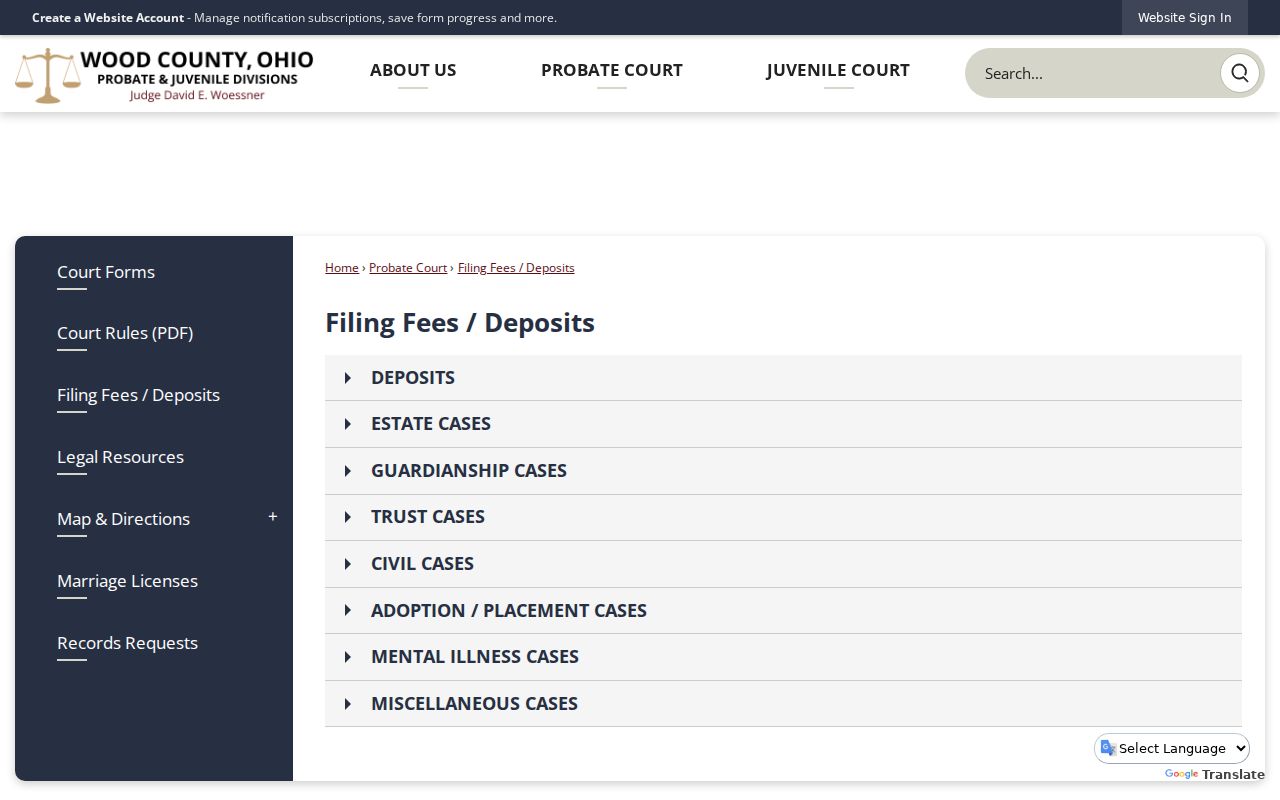
Copies and filing deposits are separate things. State the record type and copy choice to staff up front. The request form allows two requests. It asks for the case number, record type, case or party name, an approximate filing year, number of copies, and a certified or uncertified choice. Historic originals may sit elsewhere. The Rutherford B. Hayes Presidential Center and the BGSU Center for Archival Collections hold some. The Probate office can provide microfilm copies by request.
Older Wood County Court Records
Online coverage and physical custody are separate questions in Wood County. CourtView cautions that Common Pleas records before 1990 may not be online. Probate says information before 1994 can be incomplete or absent from its web search. Some originals live elsewhere. The Hayes Center and the BGSU archives hold some of those. A missing older result is not the end. Send the custodian a request instead. Include the party name, approximate year, record type, and any case number available.
The Public Records Area supplies paper and electronic docket access, microfilm equipment, and staff assistance. A historic original may not sit in the courthouse, though. Ask which copy format exists. Ask whether the case is an ordinary public record. It might also be a restricted category or material held by another repository.
What a Court Record Contains
Think of a docket as a procedural index. It is not a full set of images or an official certification. CourtView, the Clerk explains, presents docket entries drawn from its computerized records. Some field labels only appear after completing a CAPTCHA. So do not count on every item being downloadable. Name exactly what you need when you make a record request instead.
| Case number | The court-assigned identifier; retain it exactly when calling or requesting a file. |
|---|---|
| Docket entries | A chronological index of filings, orders, settings, and procedural activity. |
| Pleadings and motions | Filed papers such as a complaint, answer, motion, or indictment when public access permits. |
| Orders and judgments | Documents recording rulings or a disposition; a certified copy comes from the custodian. |
| Hearing information | Notices or entries identifying a setting, subject to the limits of the particular court’s public access. |
Want a hearing transcript? Go to the court reporter, not the Clerk's ordinary docket copies. The General Division judge directory lists which reporters serve the individual courts. That directory points to the right office.
Wood County Court Record Types
These three products answer different questions. A docket entry says an event was filed, set, entered, or acted upon. A filed document is the actual pleading, order, or judgment. A certified copy is the custodian's official version. It is issued for formal use. CourtView helps you locate the case and the event. What it cannot do is turn a search result into a certification.
- Docket entry
- The chronological case index, commonly called a docket entry by the Wood County Clerk.
- Plain copy
- A copy requested from the court or clerk without certification.
- Certified copy
- A copy authenticated by the custodian; the Common Pleas form says it must be mailed.
- Transcript
- The record of a hearing prepared through the court reporter route, not a substitute for a docket sheet.
Be specific when you request a document. A case number plus the date of the judgment entry gives the clerk a defined target. Vague phrasing like "my record" invites a follow-up, since one file can hold many docket entries and papers.
Wood County Court Record Certification
A certified copy is a separate product. It is not a plain copy or a web search result. The Common Pleas request form says certified copies must be mailed. It also lists a $1 certification charge. Probate's request form lets you choose certified or uncertified. The municipal clerk should confirm that court's certification steps.
Name the document type and the certification you need up front. A docket entry, a judgment, and a hearing transcript can each lead to different records. Each can also lead to different processing routes. CourtView and the municipal search screen help locate the case. Neither one substitutes for a certified document.
Certified Copies and Fees
Wood County publishes more than one fee reference. No single price covers every court document. The Common Pleas request form is the clearest route. Inspection is free, photocopies run $0.10 per page, and certification costs $1 per certification. The Clerk's broader fee posting adds transaction-specific charges. That includes $1 per page for certain complete-record, pleading, process, or file services. Ask for a quote whenever copying and certification are both requested.
| Custodian or item | Published amount | Important note |
|---|---|---|
| Common Pleas inspection | $0 | Shown on the Clerk public-records request form. |
| Common Pleas photocopy | $0.10 per page | Request-form figure. |
| Common Pleas certification | $1 per certification | Form says certified copies are mailed. |
| Probate case record | $0.10 per page plain; $1 per page certified | Estate, guardianship, and will record path. |
| Municipal court copies | Contact the local clerk | No current municipal traffic/copy fee was located in the inspected official sources. |
Wood County Clerk of Courts, Legal Division
One Courthouse Square
Bowling Green, OH 43402
419-354-9280
Note: the Clerk's statutory fee schedule also lists electronic transmission at $2 plus $1 per page and a $5 certificate of judgment. Those are transaction-specific services. They are not a universal copy price.
Wood County Court Record Response Timing
The Clerk's public-records policy sets a goal of responding within three business days. Real timing can vary with volume, storage location, redaction, and review. Treat that policy as a reasonable expectation for a Common Pleas request. It is not a guaranteed deadline for every court file or certified copy.
Probate says it will respond whether or not it finds the requested material. However, it states no fixed processing-day count. The municipal court also posts no certified-copy turnaround, so ask the clerk there. Do not rely on a record request for a hearing, filing, or other deadline. Confirm timing with the office that holds the file.
Wood County Court Record Transcript Requests
A hearing transcript is not just another CourtView result or a clerk photocopy. The Common Pleas judge directory identifies court-reporter roles for the individual General Division courts. Gather your details before you call. You will need the case number, the hearing date, the assigned court when known, and the proceeding requested. Then contact the appropriate judge's office or reporter route for availability and cost.
This distinction prevents a common record-request error. A docket entry may show that a hearing occurred. But the transcript is a separate product prepared through the court-reporter process. The Clerk can still supply the available docket or filed record path for the case.
Public Access and Sealed Records
Ohio court records are generally presumed open under the Ohio Rules of Superintendence. However, direct and remote access are not the same thing. The custodian can withhold personal identifiers, restricted documents, and protected case categories. Domestic Relations material is not among the general dockets. R.C. 2303.12 does not require it to be released remotely. A Juvenile lobby terminal exists, but it does not remove juvenile confidentiality limits.
Key Rules:
Ohio Sup.R. 11.10–11.16 governs court-record access, personal identifiers, restrictions, remedies, and retention.
Ohio R.C. 2303.12 requires Common Pleas recordkeeping and addresses public remote access to the general docket.
Ohio R.C. 2303.901 defines case documents while excluding personal identifiers and restricted information.
Ohio R.C. 149.43 applies to public offices and administrative records; court-case access is principally governed by the court-access rules.
Not every Wood County case is open to the public. Adult records that a judge has sealed fall under R.C. 2953.32. That statute spells out the narrow conditions for limiting access. Adoption files, mental-illness cases, sealed Probate matters, and protected Juvenile material stay off limits too. A docket search can come back empty for reasons that have nothing to do with you. An empty result is not an invitation to hunt for the file somewhere else. Ask the court that keeps the case instead. Its staff can tell you whether a lawful way exists for you to inspect it or get a copy.
For Probate files specifically, the court lays out its own request steps. Probate’s public-records guidance explains what that office requires.
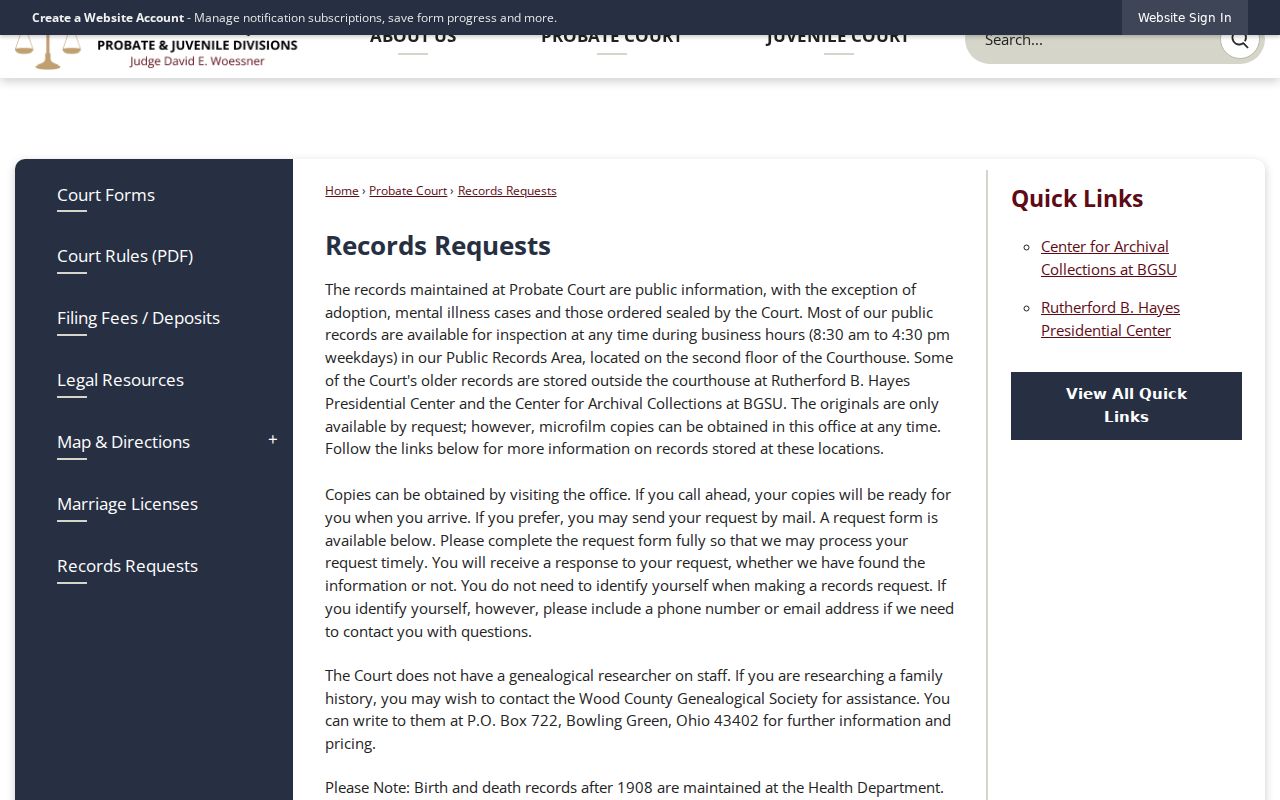
The separate Probate records area shows the local rule in practice. Access begins with the court that holds the file, and it goes only as far as that court's rules allow.